
Václav Havel Airport Prague has no train line. Every way into the city starts with a bus, a taxi, a rideshare car, or a booked shuttle, and each is priced on a different logic: public transport charges per passenger, taxis and shuttles charge per vehicle. Which is actually cheaper depends on group size, the hour, and how much luggage is coming along.
What are the actual ways to get from the airport into Prague?
There are five practical options, and they split into two cost structures. Public transport bills each traveler separately. Taxis, rideshare cars, and shuttles bill the trip, split however many ways.
- Airport Express (AE) bus + metro, or ordinary city bus + metro. Operated by Prague’s public transit company as part of the Prague Integrated Transport (PID) network. A single ticket covers the bus and a connecting metro ride, within a time limit rather than a single trip. Current fares are set by PID, not by us, and published on the PID website.
- Ordinary city bus (route 119 or 191) to a metro station. Same ticket, same network, slower than the express service but identical fare structure.
- Taxi from the official rank. Prague Airport lists the taxi operators authorized to work the terminal, with fare boards posted at the rank. Details are on the Prague Airport website.
- Rideshare (Uber, Bolt). Priced dynamically by the app, picked up from a designated zone rather than the curb outside arrivals.
- Private shuttle or shared minivan. Booked ahead, priced as a flat fee per vehicle rather than per seat.
Which option is cheapest for your situation?
Public transport tickets cost the same for a solo traveler as for a group; each person buys one. A taxi or shuttle fare doesn’t change much whether one person rides or four. That single fact is the whole decision rule.
Structurally: transit cost scales with headcount. Taxi cost scales with vehicle count. So there is a group size at which the two lines cross — the breakeven point.
Work it out like this. Call the single-person transit ticket T, and the fixed or metered taxi fare to the center F. A group breaks even once its size reaches F ÷ T, rounded up. Below that number, transit wins per person. At or above it, splitting a taxi or rideshare wins.
In practice, most sedans licensed for the airport rank hold four passengers and their luggage. That cap matters as much as the arithmetic:
- Solo traveler, daytime, carry-on only: bus + metro is almost always cheaper per person, and simple.
- Two travelers, moderate luggage: transit is usually still cheaper, but the gap narrows. Worth comparing on the day, since fares move.
- Three travelers sharing a taxi or rideshare: this is where the lines usually cross. Check the current per-ticket fare against the posted taxi rate before assuming either wins.
- Four travelers, especially with two or more large suitcases: a shared taxi or rideshare car very often beats four transit tickets, and avoids stairs and transfers entirely.
- Five or more: that’s two vehicles, or one larger shuttle van. Re-run the same comparison against the shuttle’s flat rate.
None of this requires trusting a number printed months ago. It requires checking two current figures — the PID single fare and the posted taxi rate — and doing one division.


What happens if you land after the metro stops running?
Prague’s metro does not run all night. It stops in the small hours and resumes early in the morning; exact hours are published by the operator, not by us. A night bus and tram network, run by the same operator, covers the gap but with longer intervals and no metro speed.
For a late arrival, the decision rule shifts. A solo traveler with a night bus connection nearby may still find transit workable. Anyone landing well after midnight with an early morning next-day plan, tight timing, or an unfamiliar transfer will usually find a taxi or rideshare simpler, if not obviously cheaper. Waiting alone for a night bus with luggage at 2 a.m. is a real cost, even if it isn’t priced in koruna.

Does luggage change which option makes sense?
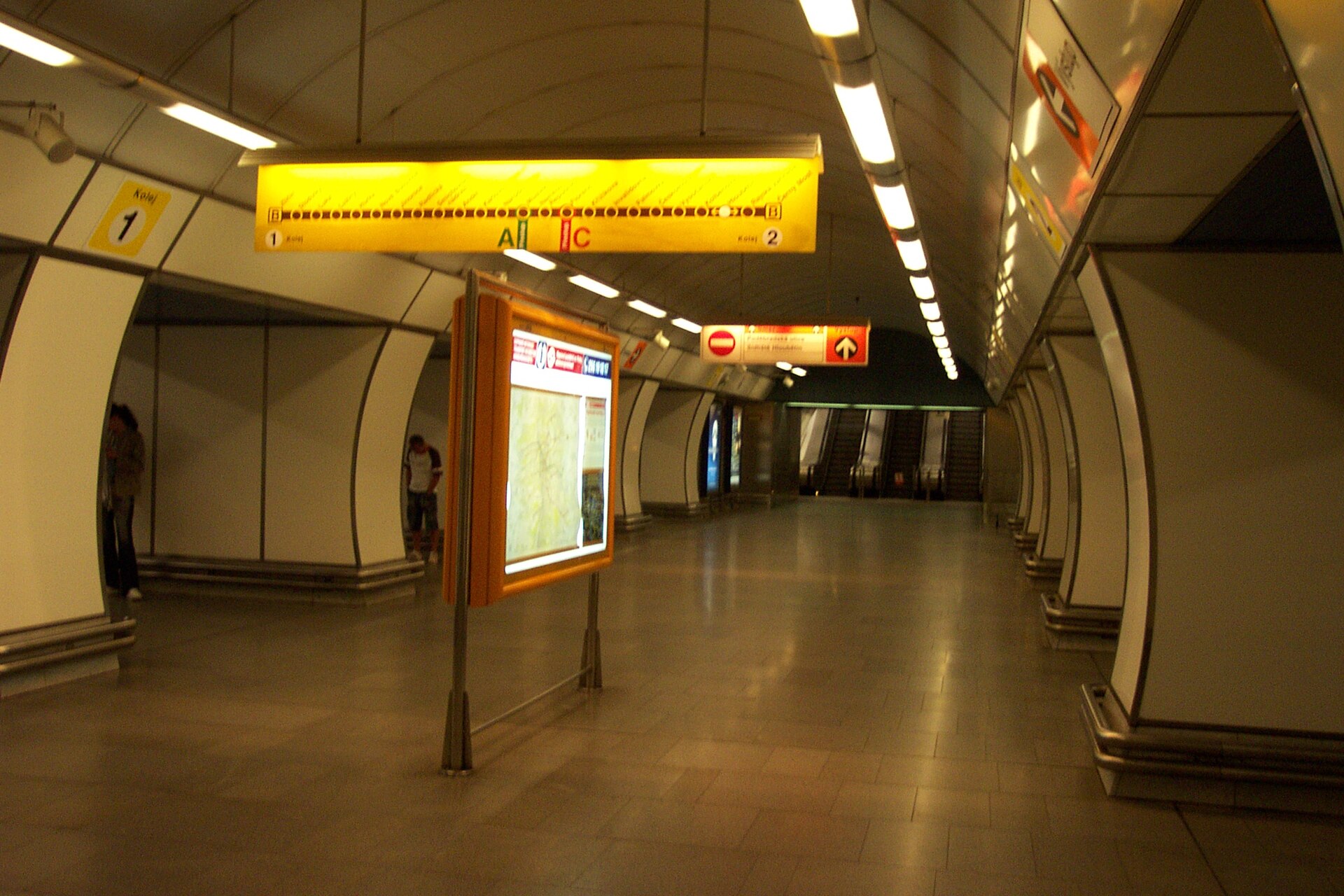
Yes, and it’s separate from price. Several metro stations on the line from the airport connection rely on long escalators, and not every station guarantees a working elevator at every entrance. Two suitcases and a stroller change that calculation regardless of the fare.
A taxi, rideshare car, or shuttle removes that variable entirely — trunk space instead of stairs. For a reader who values speed and simplicity over the last few crowns saved, that’s a legitimate reason to choose the pricier option even below the breakeven group size.
How does the bus-plus-metro ticket actually work?
The single PID ticket used for the airport bus and connecting metro ride is time-based, not trip-based — it’s valid for a set window in which transfers are free, rather than for one boarding. That structure, and what triggers a longer or shorter validity band, is explained in full in how the Prague transport ticket works, and why it’s timed. The same ticket type covers onward travel once in the city center, which is worth knowing before buying a second one unnecessarily.

What about private shuttles and shared vans?
A private shuttle is booked in advance and priced as one flat fee for the vehicle, sometimes shared with other travelers on a set schedule. It suits groups without a fixed breakeven concern, travelers with mobility needs, or anyone landing at an hour when comparing transit and taxi fares in real time isn’t appealing. It is not usually the cheapest per-person option for a solo traveler, since the flat fee is built around filling several seats.
For the wider practicalities of a first Prague trip — the koruna, tickets, and other airport-specific gaps like this one — see the airport with no train, the ticket, the koruna. Broader questions on tickets, money, and timing sit in the practical information hub, and the full run of transit explainers is collected under Getting Around.
Related reading
degrees, tank beer, the paper tab, real prices.
Access Prague is an independent guide written from published, checkable sources. We have not visited the places described here and we do not publish personal recommendations or invented ‘local favorites’ — where something is singled out as notable, we say who says so. Opening times, fares, closures and prices change at short notice, so treat everything here as a starting point and confirm with the museum, operator or venue directly before building a day around it. We give no advice on visas, insurance, health or safety; use your own government’s official guidance for those.
Featured image: Photo by Praguegirl15, source, CC BY-SA 4.0
