Why is the koruna a problem for visitors?
The koruna (Czech crown, CZK) is not the euro, and Czechia has no fixed date to adopt it. That single fact supports an entire industry of exchange booths near Wenceslas Square (Václavské náměstí) and Old Town Square (Staroměstské náměstí) built around one move: advertising a rate that almost no tourist actually gets. The loss isn’t from the currency itself. It’s from where and how it gets changed.
What is the “no commission” rate-board trick?
Many exchange booths display two boards, or one board with several rows. The top line, in the largest type, shows an attractive rate with “0% commission” printed beside it. That rate applies only above a stated volume — often 50,000 CZK or more. Below that threshold, the real rate paid to a walk-in tourist is markedly worse, commonly in the range of 15 to 25 percent less favorable, and the fee is baked into the exchange rate itself rather than shown as a separate commission line.
This is not an isolated rumor. The Czech Trade Inspection Authority (Česká obchodní inspekce, ČOI), the state body responsible for consumer protection at retail premises including currency exchanges, has carried out inspections and enforcement actions against exchange offices over exactly this kind of tiered, poorly disclosed pricing. Its findings and legal basis for regulating exchange offices are published on its own site, coi.cz.
Here is the mechanic, step by step:
- The street-facing board shows one bold rate, usually near or slightly worse than the interbank rate, with “NO COMMISSION” in large letters.
- A smaller line, often lower on the board or on a card taped near the counter, lists a threshold — for example, “rate applies from 50,000 CZK.”
- A tourist changing 100 or 200 euros, far below that threshold, is quoted a second, worse rate at the counter — not the one advertised outside.
- Because no separate “commission” is charged, the transaction technically matches the “0% commission” claim. The cost is hidden in the spread, not itemized.
Illustrative example only — not a current quote, and not what any specific booth charges today:
| Amount exchanged | Board rate shown | Rate actually applied |
|---|---|---|
| Under 5,000 CZK | Large “0% commission” rate | Often 15–25% worse |
| 5,000–50,000 CZK | Same board rate | Intermediate, sometimes better |
| Over 50,000 CZK | Same board rate | Matches the advertised rate |
The table shows a pattern, not a price. Real thresholds and spreads vary by booth and change without notice.
There is one sentence that neutralizes this. Before handing over any cash, ask the teller directly: “What is the rate for under 5,000 CZK?” A legitimate exchange must state its rate for the actual amount being changed, not the headline figure. If the quoted number doesn’t match the board, walking away costs nothing. Committing to the transaction does.

How can a rate be checked before walking into a booth?
The Czech National Bank (Česká národní banka, ČNB) publishes a daily official reference rate for the koruna against major currencies. It is not the rate any booth or bank will give a cash customer — commercial rates always sit below it — but it is the fixed point everything else is measured against. It’s published at cnb.cz, and comparing a booth’s quoted rate to that day’s ČNB figure shows the real spread being charged, in percentage terms, before any commission language enters the conversation.
A rate within a few percent of the ČNB reference rate is normal for a retail exchange. A rate 10 or more percent worse is the tiered-board scenario described above, applied at the counter rather than the window.
Which exchange booths does this affect?
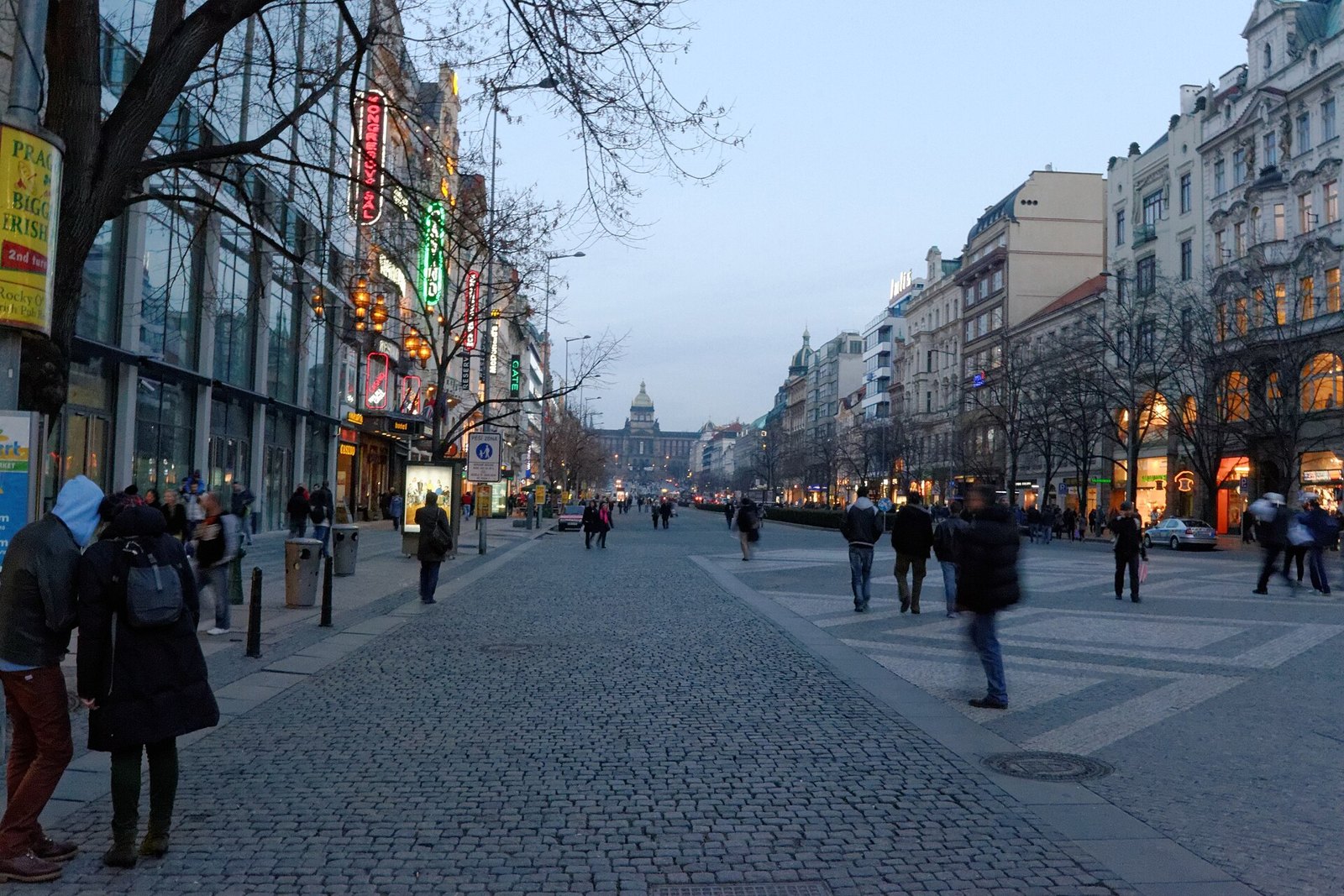
The pattern is concentrated in the highest-footfall tourist streets: Wenceslas Square, Old Town Square, and the routes between them and the main rail stations. It is a location problem, not a universal one. Exchange offices in residential districts, away from the main tourist routes, generally quote closer to the ČNB reference rate because their customers are locals who compare rates routinely and won’t return otherwise.
This is one reason background reading before a trip matters more than instinct at the counter. The first-time visitor guide covers the koruna alongside the airport and the transport ticket — the three things a new arrival has to solve within the first hour.
What about ATMs — are they safer?
Withdrawing koruna from an ATM tied to a Czech or international bank network is structurally different from a street booth. The exchange rate is set by the card network or the cardholder’s own bank, not by a shop owner with a board to design. That removes the tiered-rate trick entirely.
It does not remove every trap. Many ATMs in tourist areas now offer “Dynamic Currency Conversion” — a prompt asking whether the withdrawal should be charged in the home currency instead of koruna. That prompt should be declined. Choosing the home-currency option hands rate-setting back to the ATM operator, at a markup the cardholder’s own bank would not apply. The correct choice at that screen is always to be charged in koruna, letting the card issuer handle the conversion.
The same rule applies at card terminals in shops and restaurants. If a terminal asks “pay in EUR or CZK,” koruna is the answer that keeps the conversion under the cardholder’s own bank rather than the merchant’s.
Does it matter how the airport transfer or transport ticket is paid?
It does, mainly because early spending sets the tone for the whole trip. Airport currency counters are subject to the same tiered pricing described above, and arriving travelers, tired and rate-blind, are the target market. The airport-to-city cost comparison lays out the transfer options in koruna terms, and most of them — the public bus, the shuttle, a metered or app-based taxi — accept cards or contactless payment without ever requiring cash from a booth.
Public transport tickets work the same way. The transport ticket explainer covers how fares are structured and timed; increasingly, contactless bank cards can be tapped directly on Prague’s metro and tram validators, sidestepping both cash and the ticket machine.
Is it ever worth changing money before arriving?
Home-country banks and airports abroad rarely offer competitive koruna rates, since it is a low-volume currency for them. Converting a small amount before departure — enough for a taxi or a first coffee — has some logic as insurance against a bad first hour. Converting a large sum that way is usually the more expensive option, not the safer one.
A better approach for most visitors: bring a card with no foreign transaction fee, use ATMs inside bank branches or attached to Czech banks rather than standalone tourist-street machines, and treat any board advertising “no commission” as a prompt to ask the threshold question, not a reason to relax.
How does this differ for residents and long-stay visitors?
Anyone living in Prague for months rather than days has a simpler solution available: a Czech bank account and a domestic debit card remove the exchange-rate question almost entirely for day-to-day spending. Salaries, rent, and utilities are quoted and paid in koruna directly.
The exposure that remains is periodic — sending money home, or receiving it, where the same tiered-rate logic can apply through a money-transfer service rather than a street booth. The mechanism to check is identical: compare any quoted rate to the ČNB reference figure before committing, and ask what rate applies to the specific sum being moved, not the headline number.
What is the single habit that avoids most of this?
Treat every “0% commission” board as a partial claim until the counter rate is confirmed against the actual amount being changed. Ask the threshold question out loud. Compare against the ČNB reference rate when signal allows it. Decline every dynamic-currency-conversion prompt, at ATMs and at terminals alike.
None of this requires fluency in finance. It requires one sentence, said before cash changes hands, and a card set to convert through the issuing bank rather than the merchant. For everything else involved in a Prague trip — tickets, timing, what a neighborhood actually is — the practical information hub and the broader Prague guide cover the rest of the groundwork, and the getting-around section goes deeper on how the transport network itself is priced and structured.
Access Prague is an independent guide written from published, checkable sources. We have not visited the places described here and we do not publish personal recommendations or invented ‘local favorites’ — where something is singled out as notable, we say who says so. Opening times, fares, closures and prices change at short notice, so treat everything here as a starting point and confirm with the museum, operator or venue directly before building a day around it. We give no advice on visas, insurance, health or safety; use your own government’s official guidance for those.
Featured image: Photo by Txllxt TxllxT, source, CC BY-SA 4.0
