Charles Bridge is emptiest between about 5am and 6:30am, before tour groups and souvenir carts arrive. A second quieter stretch opens after roughly 10pm, when the statues are floodlit but the crowd thins depending on season and day of week. Everything in between is some degree of full, and the degree depends on what is feeding the bridge that hour.
There is no single “best” time. There is a best time for a given goal. A photographer wants an empty frame. Someone who just wants to cross without shuffling wants a gap in foot traffic. Someone who wants to see the bridge lit up at night wants neither dawn nor noon. The sections below separate those goals by the hour.
Why does the bridge fill and empty in waves, not gradually?
Charles Bridge sits on the single pedestrian route between Prague Castle and the Old Town, so its crowd is really three unrelated flows arriving on three unrelated schedules. They overlap in the middle of the day and almost never overlap before 7am.
The first flow is local: joggers, dog walkers, people cycling to work across the only car-free river crossing in the historic center. The second is organized groups, coaches, and walking tours timed to hotel breakfast hours and fixed excursion slots. The third is the evening leisure crowd — dinner reservations, river cruises, and sunset photographers converging from different directions at once.
What does the hour-by-hour pattern actually look like?
The table below is a general pattern built from how the bridge is used, not a measured headcount — no operator publishes bridge-specific footfall data. Treat the bands as relative, not exact.
| Time block | Who is on the bridge | What drives it | Best suited to |
|---|---|---|---|
| 5:00–6:00am | Nearly no one | Before sunrise much of the year; too early for groups | Photography, solitude |
| 6:00–7:30am | Local joggers, commuters, a few early photographers | Residents crossing to work; light is good after sunrise | Photography, a genuine quiet walk |
| 7:30–9:00am | First coach groups and walking tours | Hotel breakfast ends; guided tours start their day at the castle or the bridge | Still workable if brief |
| 9:00am–6:00pm | Dense, continuous | Independent visitors, school groups, and tour coaches overlap all day | Avoid if crowd matters more than timing |
| 6:00–8:00pm | Dinner-hour crowd plus river-cruise excursion groups | Restaurant reservations, sunset photography, evening river cruises returning or departing | Views of sunset, not solitude |
| 8:00pm–midnight | Variable | Depends heavily on season and whether it is a weekend | Night photography, lit statues |
What’s happening between 5am and 7:30am?
This is the only stretch with no organized tour traffic at all. Coaches are not yet moving and hotel breakfast service has not ended. The people present are almost entirely local: runners, cyclists, a handful of early photographers.
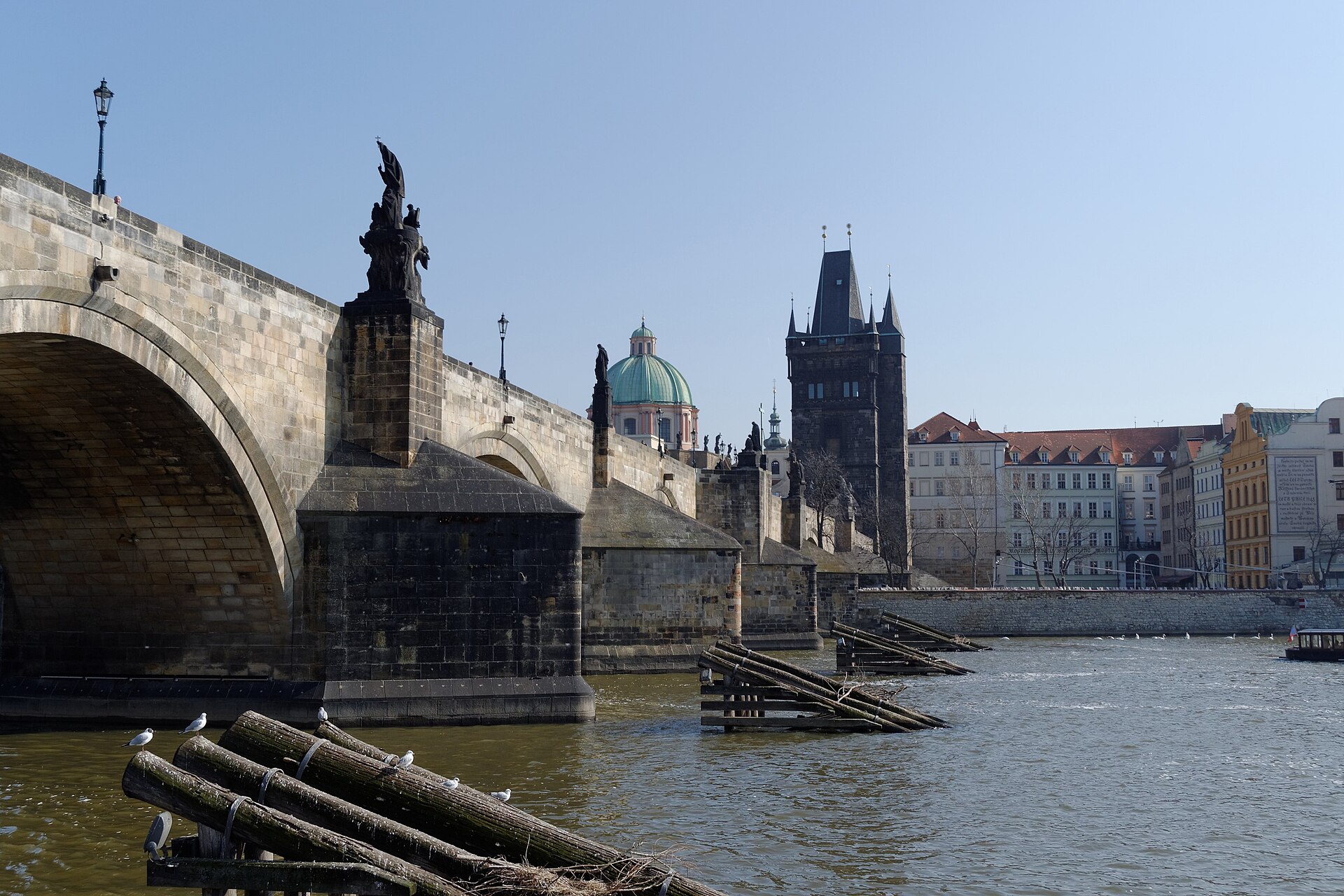
Sunrise timing shifts the exact feel. In midsummer Prague gets light before 5am; in December sunrise is closer to 7:45am. A source like timeanddate.com’s Prague sun calculator gives the specific date-by-date times, which matters if the goal is a lit sky rather than just an empty bridge. By 7am, dog walkers and a few delivery staff are around, but the bridge is still walkable without weaving.

Why does the crowd jump so sharply around 7:30am?
This is when the first wave of organized groups arrives. Walking tours commonly start at the castle and work downhill toward Old Town, reaching the bridge mid-morning, or start at the Old Town side and climb toward the castle early to beat the heat and the queues described on the castle’s own circuits.
Coach access to the historic core is restricted; groups are generally set down at fixed points and walk in, which is why the increase shows up as a wave rather than a trickle. By 9am the bridge is carrying both the independent visitors who got up early and the first scheduled groups, and the density rarely drops again until evening.
What does the midday peak actually consist of?
From roughly 9am to 6pm, the bridge runs at or near capacity most of the year. Three separate audiences are on it at once:
- Independent visitors moving between Prague Castle and Old Town Square on the most direct walking route
- Scheduled coach and walking tour groups, whose stop times are fixed by the tour operator, not by crowd conditions
- Vendors and street performers, who are present precisely because this is the highest-footfall hour
This block is unavoidable for anyone touring the castle and Old Town in a single day. The practical response is not to avoid it entirely but to budget extra crossing time, which an itinerary like the one in our one-day Prague plan already accounts for.
Why does the crowd shift character around 6pm rather than thin out?
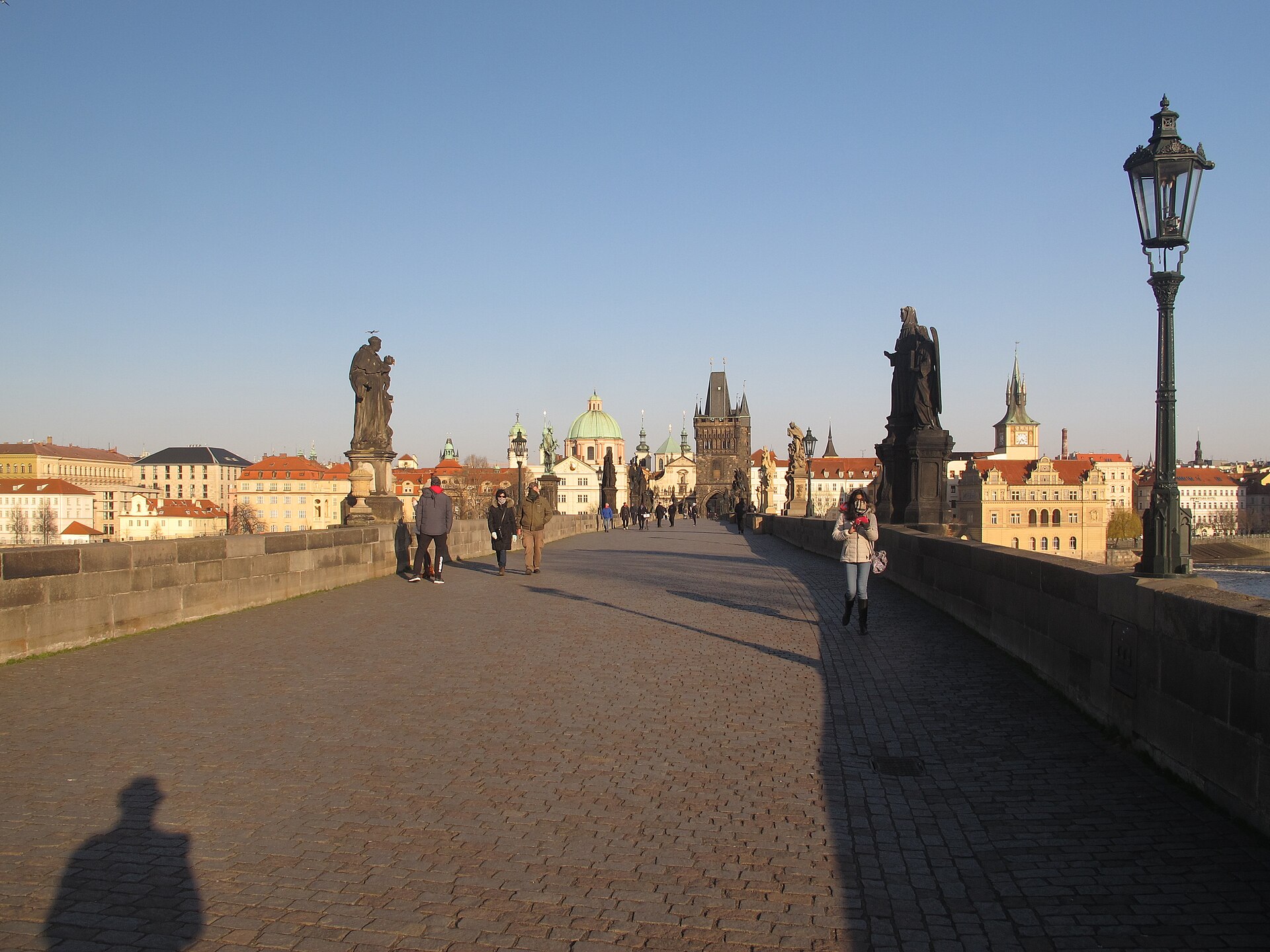
From about 6pm to 8pm the composition changes, but the density does not necessarily fall. Dinner-bound visitors move through on the way to restaurants in Malá Strana (the Lesser Town) or Old Town. Sunset draws a dedicated wave of photographers, heaviest in the hour before golden hour.
Multi-day river cruises that include Prague as a land excursion — most sail the Elbe or Danube and bus passengers in, since the Vltava itself is not used by large cruise vessels through the city — often schedule their Prague walking tours to end with an evening stop at the bridge. That adds a second organized-group layer on top of the dinner crowd, right as the light is best for photographs. It is a crowded hour, but for a specific reason.

Is the bridge actually quiet again at night?
Sometimes. After about 10pm the dinner crowd thins and most coach groups have gone back to their hotels. What’s left varies a lot by season and by day of week — a Friday or Saturday night in July is a different bridge than a Tuesday in November.
The statues and lamps are lit after dark, which is its own reason to come, separate from crowd-avoidance. Night visibility is not primarily about crowd size; it is about the floodlighting against the dark river, something no daytime visit offers. A late, cold, off-season weeknight is close to the quietest the bridge gets outside of dawn.
Which window actually fits your goal?
The right time depends on what the visit is for. Match the constraint, not the clock:
- Empty photographs, no people in frame: 5am–6:30am, any season, earlier in summer for usable light
- A quiet walk without a camera agenda: 6am–7:30am on a weekday
- Seeing it lit at night: after 10pm, expect some company, more in summer and on weekends
- Combining it with a castle visit before the crowds build: start at the castle at opening and cross the bridge by 8:30am, ahead of the midday overlap
- Accepting the crowd because the schedule doesn’t allow a gap: any time 9am–6pm, just budget extra minutes to cross
Does the day of week or the season change any of this?
Yes, on both counts. Weekends draw more leisure visitors and more locals out walking, so the midday peak runs later into the evening. Weekday mornings in shoulder season — March, October, early November — are consistently the thinnest non-dawn window, because school groups and peak-season coach volume both drop.
Winter changes the math differently: shorter daylight compresses the “early and quiet” window, but overall visitor numbers are lower, so even the midday peak is less dense than a summer equivalent. Our guide to Prague’s crowd calendar covers how this plays out across the whole city, not just the bridge.
How do you actually get there at 5:30am?
Prague’s tram and metro network runs through most of the early morning, though with reduced frequency before the first full daytime schedule starts. The nearest metro stops are Malostranská on the Lesser Town side and Staroměstská on the Old Town side, both on line A.
Night trams cover the route when the metro is closed; the operator’s own site, Prague Public Transit (DPP), publishes the current night network and timetables. How the ticket itself works — zones, validity windows, what one fare actually buys — is explained in our guide to the Prague transport ticket.
What is actually on the bridge worth stopping for, if the crowd is thin?
Charles Bridge dates to 1357, commissioned under Charles IV to replace an earlier structure, and it carries thirty baroque statues and statuary groups added mostly from the late 17th century onward, most now replicas with originals held in the Lapidarium of the National Museum. The bridge forms part of the historic center that UNESCO’s World Heritage List inscribed in 1992.
Both ends have bridge towers that can be climbed for a view along the river; current admission arrangements and hours are published by Prague City Tourism, the city’s official visitor information body, rather than fixed here. A quiet early hour is also the best time to actually look at the statues rather than just move past them, since that is impossible once the crowd sets a walking pace.
What should the rest of the day plan around this?
If the bridge is the anchor of a morning, the rest of a tight day can follow the sequencing in our one-day Prague itinerary. If the castle is also on the list, its own ticket structure and which circuit to buy is covered separately in our breakdown of Prague Castle’s circuits and what each one includes.
For broader planning — what else varies by day of the week, including which sights close entirely on a Sunday — see our archive on planning and practicalities and the wider landmarks and sights coverage on the site.
Access Prague is an independent guide written from published, checkable sources. We have not visited the places described here and we do not publish personal recommendations or invented ‘local favorites’ — where something is singled out as notable, we say who says so. Opening times, fares, closures and prices change at short notice, so treat everything here as a starting point and confirm with the museum, operator or venue directly before building a day around it. We give no advice on visas, insurance, health or safety; use your own government’s official guidance for those.